
More yield with less fertilizer: multispecies mixtures strengthen grassland
Research, Agroforestry & Biodiversity |
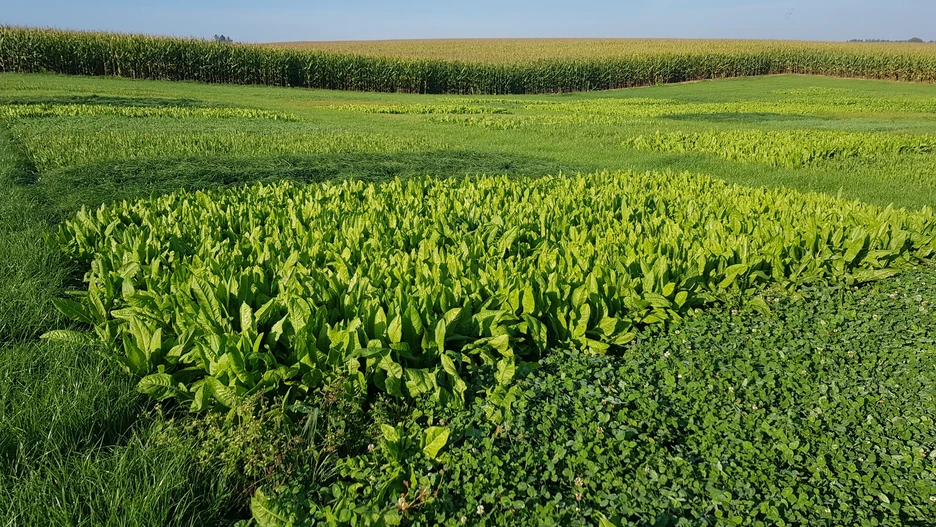
How can agriculture become more sustainable without compromising farm profits? A study published in the renowned Science magazine, with participation from TUM, shows that the use of species mixtures in intensively farmed grassland can offer advantages for yield and the environment.
Researchers from the LegacyNet project tested various combinations of grasses, legumes, and herbs at 26 locations worldwide, including TUM's land in Dürnast. They were compared with a heavily fertilized grass monoculture and a classic mixture of grass and legumes.
Diverse Mixture
The result: a mixture of two grasses, legumes, and herbs optimized yield and nitrogen savings. The optimal mixture contains 30-70% legumes, at least 15% grasses, and at least 10% herbs.
The optimal mixture showed a yield increase of over 10% compared to the clover-grass mixture and the grass monoculture, even though the grass monoculture was fertilized twice as much. Trials at locations worldwide showed that the positive effect of species mixing occurred across the entire climate gradient and is further enhanced at warmer temperatures.
Good for yields and the environment
“We have a win-win-win situation,” says Caroline Brophy, senior author of the study from Trinity College in Dublin. “The transition to mixed cropping in agricultural grasslands can lead to more ecologically sustainable feed production, improve yields, and promote adaptation to a warming climate.”
Sebastian Meyer, Professor of Ecosystem Functions and Biodiversity at the Chair of Terrestrial Ecology at TUM, emphasizes, “We know of positive diversity effects on yield primarily from extensive grassland. We show that these also work under intensive cultivation. Legumes can be used to reduce the use of mineral fertilizers, which saves costs and reduces environmental impact.” .
Further information
- Publication: Multispecies grasslands produce more yield from lower nitrogen inputs across a climatic gradient | Science
- This news on the website of the Trinity College.
- The Chair of Terrestrial Ecology is part of the TUM School of Life Sciences and the World Agricultural Systems Center - Hans Eisenmann-Forum.